
Can one score capture your investment risk?
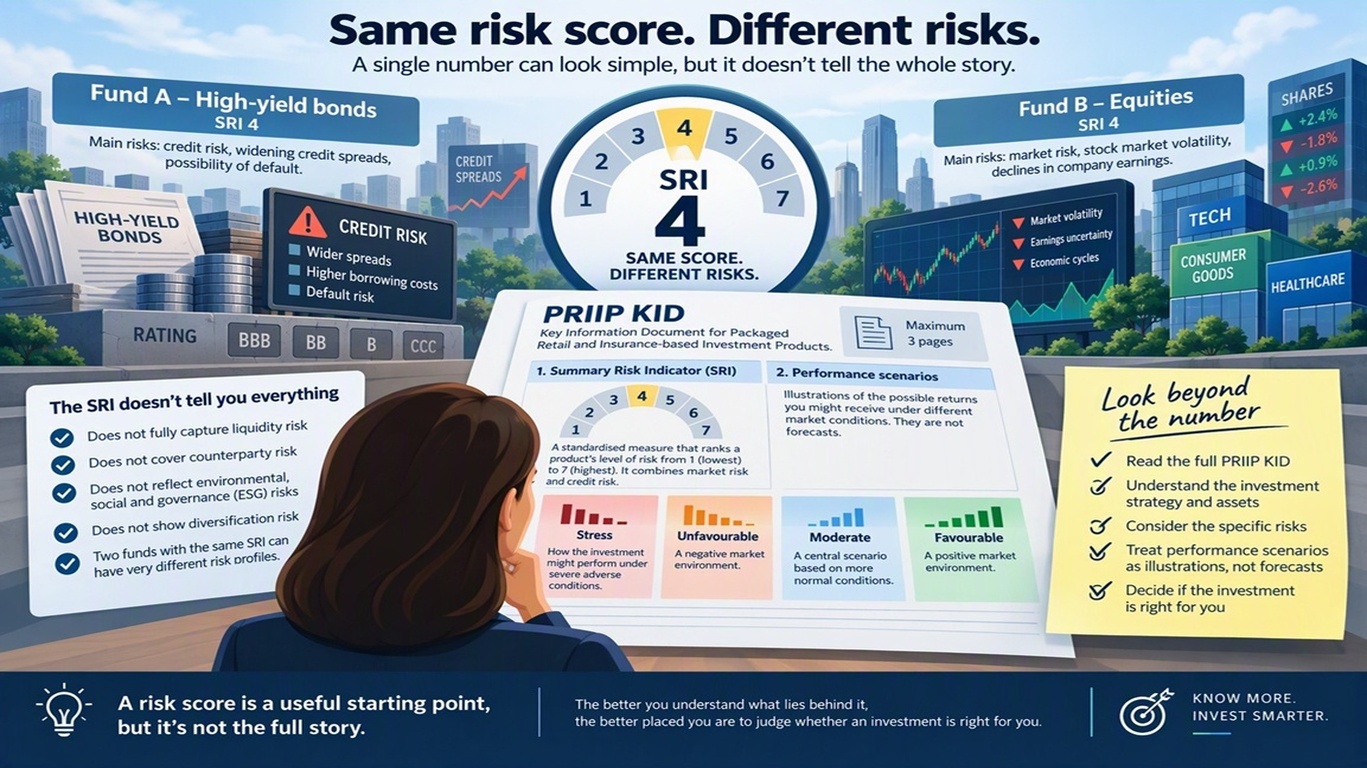
A single number can make investment risk look reassuringly simple. But two products carrying the same risk score can expose investors to very different risks. Understanding what sits behind that number is therefore just as important as knowing the score itself.

Martina Farrugia
This is where the Key Information Document for Packaged Retail and Insurance-based Investment Products, better known as the PRIIP KID, comes in. This mandatory document, limited to three pages, is intended to help retail investors understand and compare products. Yet some of its most important information, particularly the Summary Risk Indicator (SRI) and performance scenarios, still needs careful reading.
What the PRIIP KID covers
- The Summary Risk Indicator
The SRI is a standardised measure that ranks a financial product’s level of risk from 1 (lowest) to 7 (highest). It helps investors assess whether a product is in line with their risk tolerance.
The SRI brings together two main factors. The first is market risk: how sensitive the product is to market movements. The second is credit risk: the possibility that the product’s issuer may default. Market risk is calculated using measures, including annualised volatility and Value at Risk (VaR) over the recommended holding period. That would be the suggested length of time the investment should be held.
These calculations produce the product’s Market Risk Measure (MRM), while the issuer’s creditworthiness determines its Credit Risk Measure (CRM).
- Performance scenarios
Performance scenarios show the possible returns an investor might receive under different market conditions and over specified periods. They are illustrations rather than forecasts: actual returns will depend on market performance and cannot be predicted with certainty.
The document presents four scenarios – stress, unfavourable, moderate and favourable – to illustrate how the investment might perform under different market conditions. They can help investors assess whether they could tolerate periods of weak performance and understand the investment’s potential upside.
The stress scenario looks beyond normal market conditions and illustrates how adverse events could affect the fund’s performance and stability.
The same score can mask different risks
The SRI brings together market and credit risk, but it does not fully capture every risk that may matter to an investor, including liquidity, counterparty, environmental, social and governance (ESG), or diversification risks. Two funds with the same SRI may therefore have very different risk profiles.
For example, a fund with an SRI of 4 that invests in high-yield bonds will mainly be exposed to credit risk, widening credit spreads and the possibility of default. Another fund with the same SRI that invests in equities will be more exposed to stock market volatility and declines in company earnings. These distinct risks are not fully reflected in the headline score.
Look beyond the SRI
The SRI makes it easier to compare funds, but it should be treated as a guide rather than a complete assessment of risk. A fund may be exposed to several risks that the indicator does not fully reflect.
The lesson is simple: do not stop at the number. Read the SRI alongside the product’s investment strategy, the assets it holds and the risks those assets carry. Treat performance scenarios as illustrations of what might happen, not forecasts of what will happen.
A risk score is a useful starting point, but it is not the full story. The better the investor understands what lies behind it, the better placed they are to judge whether an investment is right for them.
Opinions, estimates and projections in this article constitute the current judgment of the author as of the date of publication and should not be construed as investment advice. BOVAM makes no guarantees, representations or warranties and accepts no responsibility or liability for the accuracy or completeness of the information contained in this article. BOVAM has no obligation to update, modify or amend this article, or otherwise notify a reader if any matter stated herein, or any opinion, projection, forecast or estimate set out herein, changes or subsequently becomes inaccurate. All information and data are correct at the time of publishing. BOV Asset Management is licensed by the Malta Financial Services Authority to conduct investment services in Malta under the Investment Services Act (Cap. 370 of the Laws of Malta). Issued by BOV Asset Management Limited, registered address: 58, Triq San Żakkarija, Valletta VLT 1130, Malta. tel: 2122 7311, e-mail: infoassetmanagement@bov.com, website: www.bovassetmanagement.com. Source: BOV Asset Management Limited.